Every restaurant has a collection of unglamorous, time-saving tricks that never make it into cookbooks or food shows. Here are the ones I used every day and why they’re even more useful in a home kitchen.
Disclosure: This post contains affiliate links. If you make a purchase through these links, I may earn a small commission at no extra cost to you. I only recommend products I’ve personally used or would trust in a professional kitchen.
There’s a version of restaurant cooking that gets all the attention, the flamboyant plating, the French terminology, the dramatic sauté tosses. Then there’s the version that actually keeps a kitchen running: the shortcuts.
Not lazy shortcuts. Not corner-cutting. I’m talking about the practical, battle-tested hacks that every working kitchen depends on to push out hundreds of plates a night without falling apart. The kind of stuff that never ends up on a food blog because it’s not photogenic. It’s not trendy. It just works.
After running a restaurant, I brought a lot of these habits home with me. And the thing is, most of them work even better in a home kitchen where you’re not cooking for a hundred people, you’re cooking for four.
Squeeze Bottles for Everything
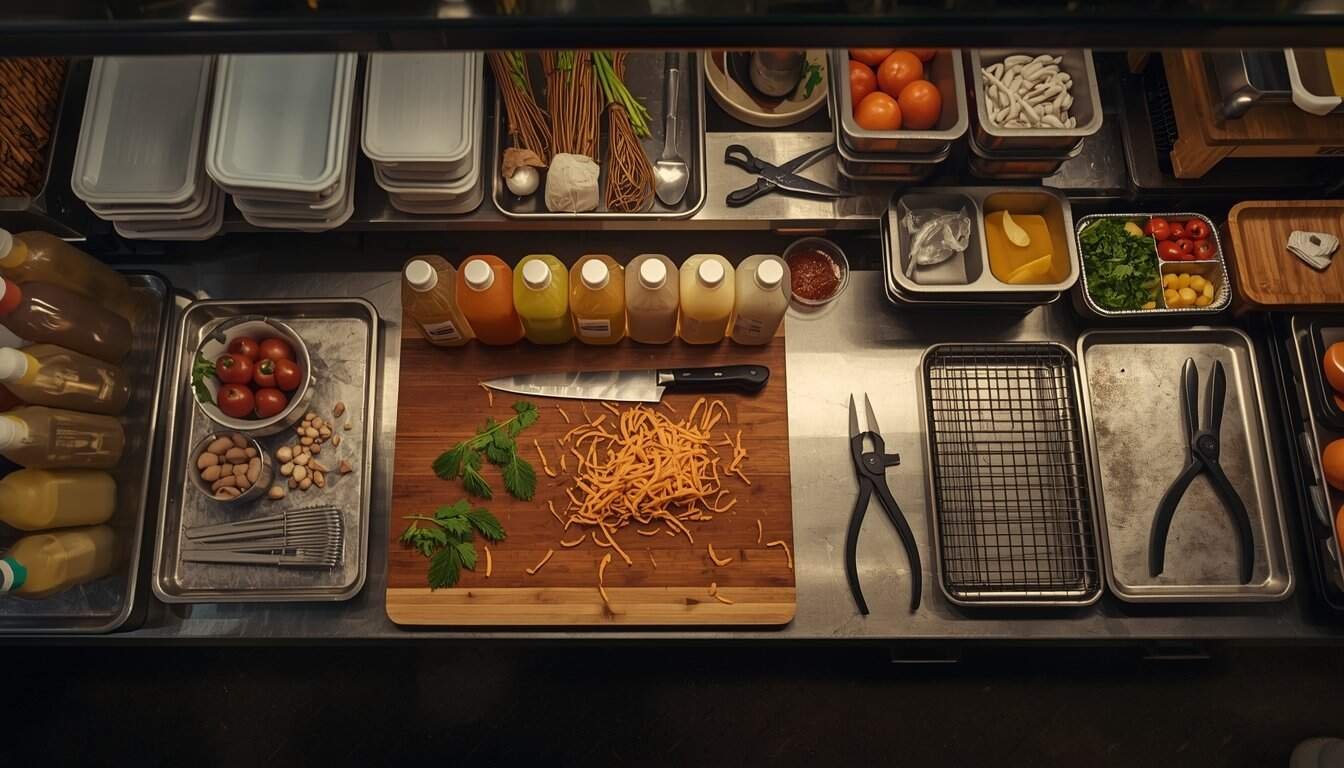
In a restaurant, oils, sauces, and dressings don’t live in their original containers. They go into plastic squeeze bottles. Every station has a row of them: olive oil, vegetable oil, soy sauce, hot sauce, balsamic glaze, garlic butter. Whatever gets used regularly goes into a squeeze bottle.
This isn’t about looking professional. It’s about speed and control. Pouring olive oil from a bottle is imprecise, you either pour too much or too little, and you’re fumbling with a cap in the middle of cooking. A squeeze bottle gives you a thin, controlled stream exactly where you want it. You can dress a plate, oil a pan, or drizzle a finishing sauce with one hand in half a second.
At home, this is a game-changer. Fill a squeeze bottle with your everyday olive oil and keep it next to the stove. You’ll use it for every meal, and you’ll wonder how you ever cooked without it. I keep separate bottles for olive oil, avocado oil, soy sauce, and a homemade vinaigrette that I make.
Deli Containers Replace Every Storage Solution You Own
Open the storage drawer in any restaurant and you’ll find one thing: stacks and stacks of clear deli containers. Quarts and pints, all the same brand, all interchangeable lids. That’s it. No mismatched Tupperware, no glass containers with missing lids, no ziplock bags.
There’s a reason every professional kitchen on the planet uses the same system: it’s cheap, it stacks perfectly, you can see what’s inside without opening it, and when one gets stained or warped, you throw it away without a second thought.
I replaced every piece of food storage in my home kitchen with restaurant deli containers. Leftovers, prepped ingredients, marinating protein, storing stock, they handle everything. My fridge has never been more organized. And because they’re all the same size, they stack without wasting a single inch of shelf space.
Sheet Pans Are Your Most Versatile Tool
In a restaurant, sheet pans are used for everything: roasting vegetables, baking proteins, catching drips, holding prepped ingredients, transporting food between stations, cooling baked goods. They’re the duct tape of the kitchen.
Most home cooks own one or two cookie sheets and use them exclusively for baking. That’s barely scratching the surface. Pair a proper half-sheet pan with a wire cooling rack that fits inside it, and you’ve got an instant roasting setup that gives you airflow on all sides of the food. Bacon comes out crispier. Roasted vegetables don’t steam in their own moisture. Breaded items stay crunchy on the bottom instead of getting soggy.
I keep four sheet pans in rotation at home. Two are usually in use, one is being washed, and one is staging prepped ingredients. They’re cheap enough that you shouldn’t hesitate to buy extras.
Kitchen Shears Do Half the Jobs You’re Using a Knife For
Here’s something you’ll never see in a cooking show but happens constantly in a real kitchen: cooks grabbing kitchen shears instead of a knife. Cutting herbs? Shears. Trimming fat off chicken thighs? Shears. Portioning pizza? Shears. Cutting parchment paper to fit a pan? Opening a package of bacon? Snipping green onions directly into a bowl? Shears, shears, shears.
A good pair of heavy-duty kitchen shears saves you from pulling out a cutting board for half the small tasks in cooking. They’re faster, they’re more precise for certain cuts, and they create zero cleanup. You snip, you’re done.
The restaurant trick: keep them on a hook or magnetic strip right next to your stove, not buried in a drawer. If they’re within arm’s reach, you’ll use them constantly. If they’re in a drawer, you’ll forget they exist.
The Bench Scraper Is the Most Underrated Tool in Any Kitchen
If you’ve never used a bench scraper, you’re working harder than you need to. In a restaurant, every cook has one within reach. It’s a flat, rectangular piece of stainless steel with a handle, and it does about fifteen different jobs.
Chopped a pile of onions? Scoop them off the board and into the pan in one motion. Need to clean flour off a countertop? One pass. Dividing dough into portions? Clean, even cuts. Transferring a pile of minced garlic from board to bowl? No more trying to scrape it off with the side of your knife and dropping half of it on the counter.
It costs less than a cup of coffee, and once you start using one, you’ll carry it around the kitchen like it’s an extension of your hand.
Taste the Cooking Liquid, Not Just the Food
This one isn’t a tool shortcut, it’s a mental one that saves you from ever producing a bland dish again. In a restaurant, we don’t just taste the finished product. We taste the liquid. The braising liquid. The pasta water. The sauce as it reduces. The marinade before the protein goes in.
Why? Because liquid tells you everything. If your braising liquid tastes flat, the meat sitting in it for three hours is going to taste flat. If your pasta water isn’t salted enough, the pasta is going to taste like nothing no matter what sauce you toss it with. If the marinade doesn’t taste punchy and slightly too strong on its own, it’s not going to penetrate the protein enough to make a difference.
At home, grab a spoon and taste your liquids early and often. Adjust before it’s too late. This single habit catches problems that would otherwise ruin a meal, and it takes two seconds.
Blend First, Strain Later
When you need a smooth sauce, soup, or puree, the restaurant shortcut is simple: don’t worry about perfect prep. Roughly chop everything, cook it, then hit it with an immersion blender right in the pot. If it needs to be silky smooth, pass it through a fine mesh strainer after blending.
Home cooks spend too much time trying to dice everything perfectly for a soup that’s going to be blended anyway. In a restaurant, the rough chop goes in, gets cooked, and gets blasted smooth in seconds. The immersion blender is the tool that makes this possible without transferring hot liquid to a countertop blender in batches which is messy, dangerous, and slow.
For anything that needs to be smooth, tomato soup, butternut squash puree, pan sauce, salad dressing in a tall container, the immersion blender is faster, easier, and creates less cleanup than any other method.
Stop Measuring, Start Weighing
Volume measurements, cups and tablespoons, are wildly inconsistent. How tightly you pack flour, how level your scoop is, even humidity can change the actual amount. Restaurants that do any baking or precise work use weight. Every time.
A digital kitchen scale costs less than dinner for two and makes you more accurate than any set of measuring cups ever will. It’s also faster: put the bowl on the scale, zero it out, add ingredients one after another, zeroing between each. No measuring cups to wash. No second-guessing whether that was really a “packed” cup or a “level” cup.
Once you start weighing, you’ll notice your baking gets more consistent, your recipes become more repeatable, and your sink has fewer dishes in it.
The Common Thread
None of these shortcuts are sexy. You’re not going to see a cooking show host rave about squeeze bottles and bench scrapers. But that’s exactly the point. The real restaurant tricks aren’t the ones that look impressive, they’re the ones that make everything run smoother, faster, and cleaner.
When I left the restaurant industry, I didn’t miss the long hours or the pressure. But I missed the efficiency. Everything had a system. Every tool had a purpose. Nothing was wasted, not time, not motion, not effort.
These shortcuts brought that feeling back into my home kitchen. They’ll do the same for yours. Start with one or two, and once you feel the difference, you’ll want the rest.
Ready to put these shortcuts to work? Browse our recipes and see how much smoother cooking feels with the right habits and tools in place.
Read Article → What Restaurant Kitchens Get Right That Home Cooks Miss
Read Article → Mise en Place: The Restaurant Habit That Will Change How You Cook
One response to “The Restaurant Shortcuts Nobody Talks About (That Work Even Better at Home)”
[…] Read → The Restaurant Shortcuts Nobody Talks About (That Work Even Better at Home)] […]