
The restaurant industry operates on notoriously thin margins, typically between 3-5% for full-service establishments. In this environment, even small improvements in menu performance can mean the difference between profitability and closure. Enter AI-powered menu optimization, a technology that’s transforming how savvy operators design, price, and evolve their offerings.
What Is AI-Powered Menu Optimization?
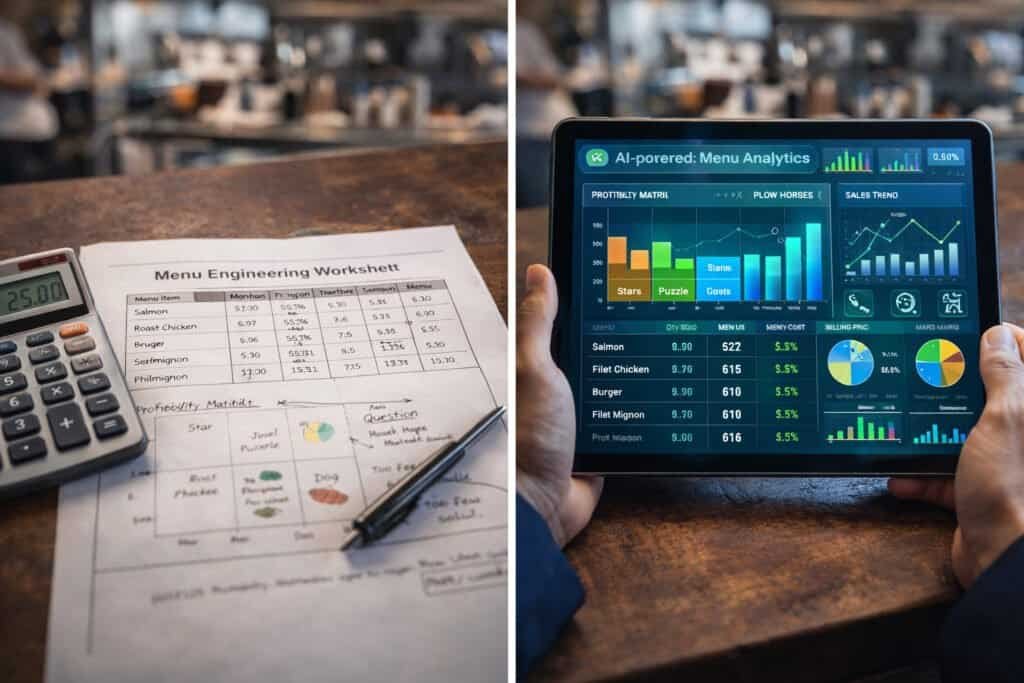
AI-powered menu optimization uses machine learning algorithms to analyze vast amounts of sales data, customer behavior patterns, and market trends to make data-driven recommendations about your menu. Unlike traditional menu engineering that relies on quarterly spreadsheet analysis, AI systems work continuously, identifying opportunities and issues in real-time.
These systems analyze:
- Item-level sales performance across different dayparts, days of week, and seasons
- Profit margins and food cost fluctuations
- Customer ordering patterns and pairing behaviors
- Competitor pricing and local market trends
- Kitchen capacity and prep time constraints
- Ingredient availability and seasonality
The Business Case: Real ROI Numbers
The financial impact of menu optimization can be substantial. According to industry data, restaurants implementing AI-driven menu strategies typically see:
Profit margin improvements of 2-8% through better pricing strategies and strategic focus on high-margin items. For a restaurant doing $2 million annually, that’s $40,000-$160,000 in additional profit.
Food waste reduction of 15-25% by identifying slow-moving items and optimizing inventory. The average restaurant wastes 4-10% of food purchased, so this technology pays for itself quickly.
Labor cost optimization of 5-12% through prep time analysis that helps streamline kitchen operations and reduce complexity.
How AI Menu Optimization Works in Practice
Dynamic Pricing
AI systems can recommend optimal pricing based on demand patterns, competitor analysis, and ingredient costs. For example, if beef prices spike 20% but your ribeye steak remains popular, the system might suggest a $3 price increase that data shows customers will accept, protecting your margins without sacrificing volume.
Item Performance Analysis
Traditional menu engineering uses a simple popularity vs. profitability matrix. AI goes deeper, considering:
- Time-based performance (lunch vs. dinner vs. weekend brunch)
- Weather correlations (soup sales spike on cold, rainy days)
- Pairing patterns (customers who order item A also order item B 67% of the time)
- Customer segment preferences (delivery customers vs. dine-in)
Menu Mix Optimization
AI identifies which items to promote, which to reposition, and which to eliminate. It might reveal that your third-best-selling appetizer actually loses money when you factor in prep time and waste, or that a sleeper item has incredible margins and should be featured more prominently.
Predictive Inventory Management
By analyzing historical sales patterns alongside upcoming events, weather forecasts, and local trends, AI systems can predict demand with remarkable accuracy—often within 5-10% variance. This means you order the right amount of ingredients, reducing both waste and stockouts.
Leading Platforms and Technologies
Several technology platforms now offer AI-powered menu optimization:
MarginEdge combines invoice processing with menu engineering, automatically tracking food costs and flagging margin erosion in real-time.
Plate IQ uses AI to audit invoices, track item costs, and analyze menu performance, identifying specific items where costs are creeping up.
Toast has integrated predictive analytics into their POS platform, offering item-level insights and recommendations based on millions of transactions across their network.
Crunchtime provides enterprise-level menu optimization with sophisticated forecasting that accounts for local events, weather, and historical patterns.
Voila.ai focuses specifically on menu optimization using machine learning to recommend changes based on your specific restaurant’s data.
Implementation Best Practices
Start With Quality Data
AI is only as good as the data it analyzes. Before implementing menu optimization technology:
- Ensure your POS system accurately tracks item-level sales
- Implement proper recipe costing with up-to-date ingredient prices
- Track waste and comps systematically
- Maintain consistent item naming and categorization
Begin With a Pilot Program
Rather than overhauling your entire menu based on AI recommendations, test changes incrementally:
- Select 5-10 items for initial optimization
- A/B test pricing changes on different days or dayparts
- Measure results over 4-6 weeks before scaling
- Train staff on any menu changes to ensure proper execution
Combine AI Insights With Human Expertise
AI provides powerful recommendations, but it doesn’t understand your restaurant’s unique positioning, brand identity, or chef’s vision. The best results come from using AI as a decision-support tool rather than autopilot:
- Review AI recommendations with your chef and management team
- Consider how changes align with your brand and customer expectations
- Factor in qualitative feedback that AI might miss
- Use AI to identify opportunities, then craft solutions that fit your restaurant
Monitor and Iterate
Menu optimization isn’t a one-time project—it’s an ongoing process:
- Review AI dashboards weekly to spot emerging trends
- Adjust seasonal menus based on predictive demand forecasting
- Test new items in strategic positions identified by AI
- Track the impact of changes and feed learnings back into your strategy
Common Pitfalls to Avoid
Over-optimization: Removing every low-margin item can strip your menu of variety and customer favorites that drive traffic even if they don’t maximize profit per plate.
Ignoring qualitative factors: An item might test poorly in AI analysis but serve an important role in your brand identity or satisfy a dietary need that brings in customers.
Analysis paralysis: Don’t wait for perfect data. Start optimizing with the information you have and improve data quality over time.
Set-it-and-forget-it mentality: AI recommendations are based on patterns that can shift. Regular review is essential.
The Future of Menu Optimization
Emerging technologies are making menu optimization even more powerful:
Computer vision AI can analyze plated dishes to ensure consistency and proper portioning, directly impacting food costs.
Natural language processing mines online reviews and social media to identify which menu items generate buzz and which disappoint.
Integration with supply chain data allows real-time menu adjustments based on ingredient availability and pricing.
Personalized digital menus can highlight different items to different customers based on their preferences and ordering history.
Getting Started
For most restaurants, the path to AI-powered menu optimization begins with their existing technology stack:
- Audit your current data capture: Can your POS track item-level sales, modifiers, and waste? If not, this is your starting point.
- Calculate true costs: Implement recipe costing that includes labor, not just ingredients. Many AI platforms can help automate this.
- Choose the right platform: For independent restaurants, MarginEdge or Plate IQ offer accessible entry points. Multi-unit operators might need Crunchtime or similar enterprise solutions.
- Commit to data-driven culture: The technology is only valuable if you actually act on the insights. Build review of AI recommendations into your regular management meetings.
The Bottom Line
AI-powered menu optimization isn’t about replacing human creativity and expertise—it’s about augmenting it with data-driven insights that would be impossible to generate manually. In an industry where margins are thin and competition is fierce, restaurants that leverage AI to continuously refine their menus gain a significant competitive advantage.
The technology has matured to the point where it’s accessible to independent restaurants, not just large chains. With implementation costs often recovered within 2-3 months through improved margins and reduced waste, the question isn’t whether you can afford AI-powered menu optimization—it’s whether you can afford not to implement it.
Start small, measure results, and scale what works. Your menu is your most powerful profit lever—it’s time to optimize it with the same sophistication that other industries brought to their operations years ago.